REKA BYTES / FIELD NOTE
Green isn't proof — we make an AI watch the tape
Hiring a QA tester was never in the budget for a studio our size, so we built our own: tooling that films every UAT run and hands the tape to an AI that debugs what it sees — with screenshots as evidence.
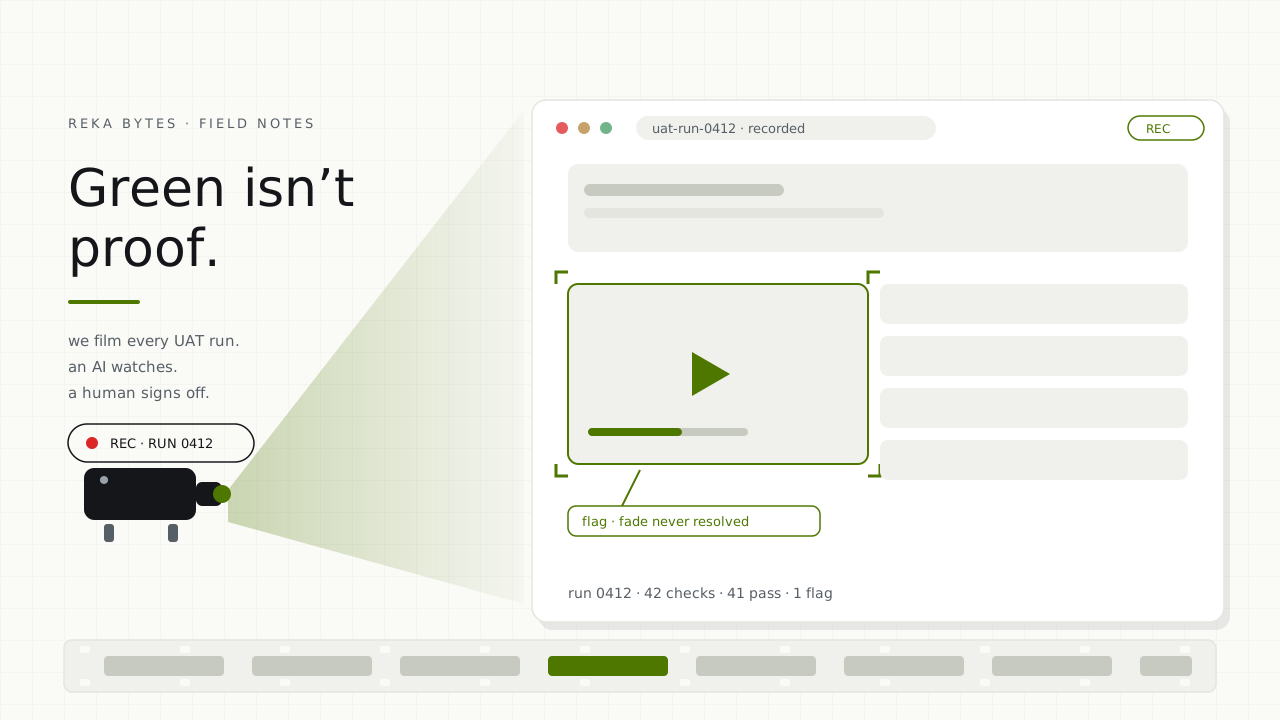
A test suite can pass while the app is broken. We learned that the honest way: a headless probe reported "latch works, unlock works," we pushed the branch, and a human playtest broke it an hour later with one double-tap the probe's busy page was too slow to reproduce. That story made it into the field report as one sentence — a probe that has no hands is a probe that confirms, not a probe that judges.
That sentence became a department.
The part small studios rarely say out loud
We can't afford a QA tester. A good one costs more per month than most MVP budgets we quote — and UAT is a must anyway, on every web app, every mobile app, every piece of software with a screen. Something has to stand at the gate before handover and answer, with evidence, "does this work for the person who paid for it?"
For years the industry's answer was a checklist: a tester clicks through a document of steps and initials each row. The checklist has a flaw everyone has learned to live with — assertions measure what the code did, not what the product looked like doing it. A log can be green while a screen flickers, an effect freezes instead of fading, or a list renders a beat behind its own header. Nothing in the report catches it, because nothing in the report was watching.
So we stopped trusting the report alone — and since we couldn't hire the watcher, we built one.
Our UAT tester is a tool we wrote
We built our own UAT tester: in-house tooling that drives the app the way a real user would, films every run, and captures a screenshot at the exact moment something looks wrong. The tape and the screenshots go to an AI model — a fast one — that debugs what it sees, not just what the log claims. When it flags an issue, it doesn't say "looks weird" — it attaches the frame that proves it. Show me beats tell me. A bug report with a screenshot attached starts the conversation at "fix this," not "is this even real?"
What does "watching" mean? Not reading the log — reading the screen. Did the page load before the data arrived? Did that toast disappear or is it still there on the seventh run? Did the form's error state show up for the user, or only in the log? The AI watches every run, not just the last one, and it never gets bored on run forty.
Then a human watches what the AI flagged. That order matters. The AI is the audience; the human is the critic; and the client signs off on footage — not on a wall of green checkmarks.
Why this matters if you're a non-technical founder
Traditional UAT puts the burden on you. You're handed a staging link, told to "play around," and quietly blamed later for not poking the one corner that broke. Our way flips the burden: you review a screening, not a checklist. The question you're asked isn't "did you test everything?" — it's "here's the tape, here's what the AI noticed, do you accept?" Acceptance becomes something you can actually do with eyes, not something you have to fake with trust.
It also changes what "done" means. Our builds don't go out when the tests pass; they go out when the tape reads clean — or when the flags that remain are the ones you looked at and accepted. That's a different kind of handover, and it's the only kind we're comfortable putting our name on.
We'll be honest about the tradeoff, because the tape would show it anyway: an AI audience misses things a practiced human eye would catch, which is exactly why the human pass exists. The AI buys coverage and stamina; the human buys judgment. Neither is optional.
Why our way isn't easy to copy
The tools that record a screen are free; the discipline is not. What makes this work isn't the recording — it's the loop: everything the AI catches gets written into the codebase as a named rule, so the same mistake never reaches the tape twice. That loop is tuition from every project we ship, compressed into standards we hold every build to. We'll gladly tell you the standard we hold your app to. The setup that enforces it stays ours — the same reason a restaurant tells you the recipe's standard but not the kitchen.
Want your build screened before you sign off on it? Start a project — the free consultation and the mockup are part of the deal.